
Friday, December 31, 2010
TBI effects in school


Wednesday, December 22, 2010
Another unfortunate incident
I understand that in Florida, where this occurred, there is a law that make the assault on a sports official more severe. I hope they take every appropriate step against this young man to help him to understand how wrong he was.
No surprises with RTP delay increases after TBI
According to a recent article in the American Journal of Sports Medicine, kids who sustain a TBI are less likely to return to play within a week if they have neurocognitive testing performed as part of their treatment. While this is probably a valid reason for using the testing, (and I doubt that the testing is that cause of any increase in impairments) I can think of several coaches who will have a very difficult time with understanding this issue. I have already have heard several comments about how coaches will not refer to an ATC who will use the testing so that they can get their star athlete back in the game sooner. Talk about a disgusting problem waiting to happen. Fortunately, these coaches are in the overwhelming minority and I pray they are not in a head position that could result in an unfortunate situation.
Of course, the other disturbing finding in this study was that the vast majority of the TBIs were a result of a head to head hit. The kind of hit that was called far too infrequently in high school football this past season as a penalty.
Finally, ESPN The Magazine also had an interesting, informal poll that asked various people who are involved in high school athletics and their attitudes towards TBIs. The Concussion Blog as a short summary of it on their pages.
Of course, the other disturbing finding in this study was that the vast majority of the TBIs were a result of a head to head hit. The kind of hit that was called far too infrequently in high school football this past season as a penalty.
Finally, ESPN The Magazine also had an interesting, informal poll that asked various people who are involved in high school athletics and their attitudes towards TBIs. The Concussion Blog as a short summary of it on their pages.
Monday, December 20, 2010
Irresponsible authors are also making it difficult to keep TBIs relevant
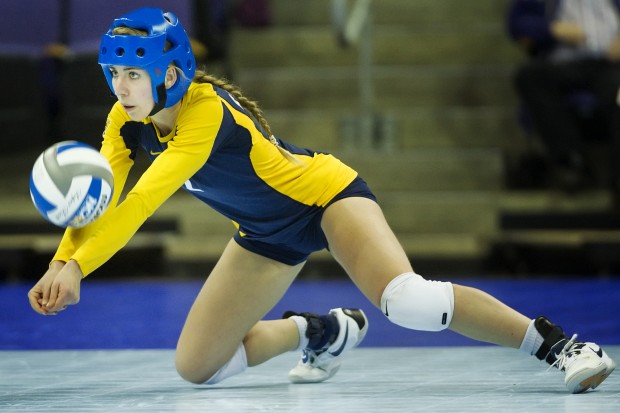
In a short commentary on a picture of Cal’s Robin Rostratter playing volleyball with a helmet on, the author questions the necessity of wearing the helmet. I am appalled by the complete lack of professional responsibility on the author's part to not investigate why the helmet was needed. The author states that is has to do with a previous TBI, but does not say anything more than that. I had a situation early in my career where a young basketball player consistently would end up with a TBI with even the slightest hit to the head. My colleagues helped me look for answers to allow the young lady to continue to play and we wished we could have found a helmet like this for her to wear. While it may not have prevented all of the TBIs that can occur from hitting her head repeatedly, she may have been able to avoid the symptoms returning from the common, mild knocks to the head. I find this commentary on this article to be sickening in light of the current climate that athletic departments face concerning the issue of TBIs. I would even be willing to bet that the author of this commentary had no direct contact with the student-athlete, the game, or the program at Cal and simply saw a picture that they felt they needed to comment on.

Tuesday, December 14, 2010
Irresponsible behavior by the few makes it harder for everyone
Today there are two stories that I have come across that describe the irresponsible behaviors that make the public so skeptical of everyone who tries to play by the rules. In the first article, a physician in New Jersey passed away suddenly from a heart attack. While tragic, this event is what caused the rest of the story to bubble to the surface. It turns out that an exceptional number of law enforcement and fire fighting personnel were interested and dismayed at the news despite the fact the physician had no official ties to either department. The public servants all knew this physician because he was writing illegal prescriptions for steroids for them. He was their dealer. If that isn't bad enough, most of the pharmaceuticals were being paid for by the public servants' insurance. You guessed it, the insurance was paid for, at least in part, with municipal taxes. The estimated cost to taxpayers was in the tens of millions.
The second article hits even closer to home since it is a story of negligence in the athletic world. It seems that there are still coaches that will recommend a student-athlete not seek medical attention to rule out a possible TBI. This is no surprise to me since I still hear these kinds of stories often enough to make them disturbing. I still find it extremely foolish for a coach who has no medical background whatsoever to "make a diagnosis" on his or her own and give medical advice. Yes, they are practicing medicine when they do this and it needs to addressed. Otherwise, it is only a matter of time before the coach tells the wrong thing to the wrong athlete and they end up fighting litigation due to some tragedy.
The second article hits even closer to home since it is a story of negligence in the athletic world. It seems that there are still coaches that will recommend a student-athlete not seek medical attention to rule out a possible TBI. This is no surprise to me since I still hear these kinds of stories often enough to make them disturbing. I still find it extremely foolish for a coach who has no medical background whatsoever to "make a diagnosis" on his or her own and give medical advice. Yes, they are practicing medicine when they do this and it needs to addressed. Otherwise, it is only a matter of time before the coach tells the wrong thing to the wrong athlete and they end up fighting litigation due to some tragedy.
Sunday, December 12, 2010
TBI symptoms differ between genders
It is interesting to note that according to recent research cited here, that boys and girls will report different symptoms after sustaining a TBI. According to this article and the research it cites, boys will more often complain of "amnesia and confusion/disorientation, whereas girls tend to report drowsiness and greater sensitivity to noise more often."
The fun part about this research is that I have been closely tied to it for about 4 or 5 years. The research is called "High School Reporting Information Online." It is run by Dr. Dawn Comstock of the Ohio State University medical center and tracks injury rates of children across the country in various high school sports. I have been reporting our schools' injuries to the study for several years. It is always fun to see that our school is contributing (even if it just a small percentage) to the kind of research that is being done here. While this is not the first time I have seen this High School RIO study cited in an article, this is one of the more interesting results that have been found by the study. It is certainly very practical and useful information in the hands of all high school ATCs.
 I will also be looking forward to the January Journal of Athletic Training to see the article that is mentioned in this publication.
The fun part about this research is that I have been closely tied to it for about 4 or 5 years. The research is called "High School Reporting Information Online." It is run by Dr. Dawn Comstock of the Ohio State University medical center and tracks injury rates of children across the country in various high school sports. I have been reporting our schools' injuries to the study for several years. It is always fun to see that our school is contributing (even if it just a small percentage) to the kind of research that is being done here. While this is not the first time I have seen this High School RIO study cited in an article, this is one of the more interesting results that have been found by the study. It is certainly very practical and useful information in the hands of all high school ATCs.
Monday, December 6, 2010
US News and World Report Article
Athletic Training was ranked as one of the top 50 careers for 2011. The projections for the 8 years has athletic training job creation outpacing nearly every other healthcare field at a staggering 34%. Most of those jobs are expected at the high school level.
 From what I have seen transpire over the last few months in the media, I find this very easy to believe. However, budgets still need to improve at schools in order to see this kind of growth, even with the amount of attention that is being placed on this shortage. I do hope that this will happen at least as well as is forecasted. The shortage may even push salaries higher for all of us and help attract more young people to the profession.

That didn't take very long.
Just over 1 week after the start of the winter season and we already have our first postponement due to poor weather. This usually doesn't occur until after Christmas in our area, so I truly hope that this is not a sign of what is to come this winter season.
Sunday, November 28, 2010
A seminar on ImPACT
A couple of weeks ago, a few of my colleagues and I travelled to Pittsburgh to attend a seminar on the use of the ImPACT software for TBI testing. (Never mind that Pittsburgh is a really tough place to navigate for someone who has never been in the city.) The course was an excellent presentation that offered a full explanation on how to interpret the scores that student-athletes will receive after taking the exam. It also was highly productive in understanding some of the errors that may occur in the test because the student athlete did not follow directions on the exam. While I have had some previous experience with the software, hearing about some of the subtleties of the scoring will certainly help in the interpretation of the scores. I am looking forward to implementing the program in full after the first of the year.

Thursday, November 11, 2010
The CDC offers a lot of resources free
Another website that has a lot of lockerroom material to hang on posterboards for coaches. The CDC offers many of them free of charge.
Addendum 11/18/2010:
Also, the Defense Centers of Excellence has some resources that are more applicable to military personnel, but the concepts are very similar.
Addendum 11/18/2010:
Also, the Defense Centers of Excellence has some resources that are more applicable to military personnel, but the concepts are very similar.
Tuesday, November 2, 2010
I hope the NATA sends the AAN a big fruit basket for Christmas this year.
The American Academy of Neurology (AAN) released a statement that gave athletic trainers a huge endorsement for what we do every day. "The AAN issued five specific guidelines in the statement, which recommends that any athlete suspected of having a concussion should be removed from participation until he or she is seen by a physician trained in the evaluation and management of sports concussions, and that an athletic trainer should be present at all practices and games where a concussion might occur." Needless to say, this can offer athletic trainers some additional job security in this very tight economy. That is something that everybody is looking for today.

Another part of their statement states that a neurologist or a physician with proper training should be referred to when return to play decisions are being made for any athlete who has been diagnosed with a TBI. Once again, I feel they are reinforcing a point that all athletic trainers would agree with. In particular, I would hate to see a physician allow a kid to RTP when their field of practice doesn't require them to be well versed in TBIs, such as a urologist or an obstetrician. While they may be very good at what they do, most specialists who have not been trained to work with TBIs have not been exposed to it since medical school.
Another part of their statement states that a neurologist or a physician with proper training should be referred to when return to play decisions are being made for any athlete who has been diagnosed with a TBI. Once again, I feel they are reinforcing a point that all athletic trainers would agree with. In particular, I would hate to see a physician allow a kid to RTP when their field of practice doesn't require them to be well versed in TBIs, such as a urologist or an obstetrician. While they may be very good at what they do, most specialists who have not been trained to work with TBIs have not been exposed to it since medical school.
Wednesday, October 27, 2010
The next big issue for athletic departments to deal with
I have quickly seen more attention being turned to energy drinks being consumed before athletic participation, especially before competition. The health risk that this poses is often being overlooked by the kids that are consuming the beverages despite the not so ominous warnings on the side of the cans. The biggest problem is that a lot of these beverages contain ridiculously high levels of caffeine and /or caffeine-like stimulants (such as guarana). The caffeine introduced into the body artificially increases heart rate before activity. Once the athlete begins exercise, the HR continues to increase as a normal function of exercise. This combination can result in some dangerous arrhythmia's due to the increased stress on the cardiac tissue. Caffeine is also a well known diuretic. It increases urine volume. This can lead to faster dehydration and heat illness during exercise.

Furthermore, the other substance commonly found in this drink is taurine, a naturally occurring amino acid that the body uses during exercise. Dietary intake is usually sufficient to supply what the body needs in order to function. However, because of some perceived benefits from taurine during exercise, it didn't take long for enterprising individuals to create a way of synthesizing it and adding it to other products in large doses to products. The theory was once again, "If a little helps me, a lot should help me more." Currently, research is looking into how taurine helps in the development of the central nervous system and its effects in large doses. There is some controversy as to whether it works as a stimulant or a depressant. "In a recent article from MedicalNewsToday.com, researchers at Weill Cornell Medical College in New York say they were “surprised” to find taurine “extraordinarily active” on brain receptors. Even though taurine is known to be a key amino acid, the researchers say they’re curious and puzzled still about the function of taurine in the brain, and have more questions than answers."
I realize I may be pushing limits of tolerance with everything that has changed with respect to TBIs and some upcoming issues on heat illnesses, but I will be pushing to get these drinks banned from the school because of their use before competition in athletics. I also understand that I have my work cut out for me since the marketing of these drinks has been so heavy towards sporting events, especially the "extreme sports." The marketing has allowed people to believe that these drinks are actually meant for people who exercise, and therefore; are completely safe.

Furthermore, the other substance commonly found in this drink is taurine, a naturally occurring amino acid that the body uses during exercise. Dietary intake is usually sufficient to supply what the body needs in order to function. However, because of some perceived benefits from taurine during exercise, it didn't take long for enterprising individuals to create a way of synthesizing it and adding it to other products in large doses to products. The theory was once again, "If a little helps me, a lot should help me more." Currently, research is looking into how taurine helps in the development of the central nervous system and its effects in large doses. There is some controversy as to whether it works as a stimulant or a depressant. "In a recent article from MedicalNewsToday.com, researchers at Weill Cornell Medical College in New York say they were “surprised” to find taurine “extraordinarily active” on brain receptors. Even though taurine is known to be a key amino acid, the researchers say they’re curious and puzzled still about the function of taurine in the brain, and have more questions than answers."
I realize I may be pushing limits of tolerance with everything that has changed with respect to TBIs and some upcoming issues on heat illnesses, but I will be pushing to get these drinks banned from the school because of their use before competition in athletics. I also understand that I have my work cut out for me since the marketing of these drinks has been so heavy towards sporting events, especially the "extreme sports." The marketing has allowed people to believe that these drinks are actually meant for people who exercise, and therefore; are completely safe.
Sunday, October 24, 2010
For the parents that could "use a little help"

Wednesday, October 20, 2010
Another resource for proper tackling techniques
Information for avoiding TBI through proper tackling technique can be found on this webiste from USA football.


Tim Tebow 2009

Eric Legrand 2010
Tuesday, October 19, 2010
It is time to return to more judicial use of tapings
Lately, a lot of kids have been dropping into the training room and demanding to get their ankles taped. Many are doing it because they have recently "tweaked" their ankle or "rolled" it and they are afraid it will get worse. Fair enough, but the statement is getting abused by those who want "game day tape jobs" or just like "the way it feels", the "tightness of it" or think that it somehow makes them run faster. Unfortunately, this abuse has taken a toll on the limited supplies that I have each year. (Yes boys and girls, I did say limited supplies and they have to last the whole year.)
While I am sure this will create some arguements, the first thing that needs to change is that nobody will be taped indefinitely after an injury. I have some athletes who had a mild ankle sprain as a freshman and still claim to need it as a senior. That will end with the start of winter season.
Also, the practice of coaches "sending kids in to get taped" and getting back out on the field will end. I will not be taping kids just to satisfy a coach, who with no medical training, thinks they have the authority to dictate the treatment. While this has not been a very big issue at our school, this can be an issue with visiting teams. I will be requiring some form of documentation from visiting schools' ATC or physician that they need to be treated with tape before I do it.

While I am sure this will create some arguements, the first thing that needs to change is that nobody will be taped indefinitely after an injury. I have some athletes who had a mild ankle sprain as a freshman and still claim to need it as a senior. That will end with the start of winter season.
Also, the practice of coaches "sending kids in to get taped" and getting back out on the field will end. I will not be taping kids just to satisfy a coach, who with no medical training, thinks they have the authority to dictate the treatment. While this has not been a very big issue at our school, this can be an issue with visiting teams. I will be requiring some form of documentation from visiting schools' ATC or physician that they need to be treated with tape before I do it.
Subscribe to:
Posts
(
Atom
)